
Australian small businesses are being targeted by cyber criminals at record rates — and most aren’t ready. Here’s a plain-English guide to the threats, the protections that matter, and how to build a security posture that actually holds up.
There’s a persistent myth in small business that cyber attacks are something that happens to big companies — banks, hospitals, government departments. The reality is almost exactly the opposite. Cyber criminals increasingly target small and medium businesses precisely because they tend to have weaker defences, less IT oversight, and more to lose from disruption than they have budget to recover with.
For Melbourne businesses — whether you’re a professional services firm in the CBD, a trade business in the south-east, or a healthcare practice anywhere in between — the question is no longer whether you need to take cyber security seriously. It’s how to do it without it consuming your entire IT budget or requiring a dedicated security team.
This guide gives you a practical, no-jargon overview of the threat landscape, the protections that make the biggest difference, and how a Melbourne-based IT partner like Care IT can help you get there.
The threat landscape: what Melbourne businesses are actually facing
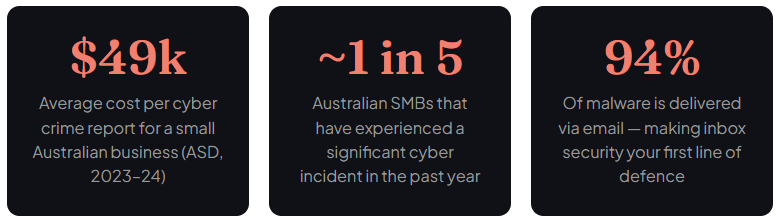
The Australian Signals Directorate (ASD) publishes an Annual Cyber Threat Report each year, and the picture it paints for small businesses is sobering. Cybercrime reports to the Australian Cyber Security Centre (ACSC) have grown year on year, with small businesses reporting average losses in the tens of thousands of dollars per incident — before factoring in the cost of downtime, reputational damage, and recovery.
Here are the five threats most commonly affecting Melbourne SMBs right now:
- Phishing and spear-phishing Deceptive emails that impersonate trusted senders — banks, the ATO, suppliers, or even your own colleagues — to trick staff into clicking malicious links or handing over credentials. Spear-phishing takes it further, with personalised messages researched from LinkedIn or your website.
- Ransomware Malicious software that encrypts your files and demands payment for the decryption key. Modern ransomware gangs also exfiltrate your data before encrypting it — threatening to publish sensitive client or business data if you don’t pay. Backups alone are no longer sufficient protection.
- Business email compromise (BEC) Attackers gain access to — or convincingly impersonate — a company email account, then use it to redirect payments, request fraudulent transfers, or harvest information. BEC losses in Australia are consistently among the highest-value categories of cyber crime.
- Credential theft and account takeover Stolen username/password combinations — often sourced from data breaches on other platforms where your staff reused passwords — are used to access business systems, Microsoft 365 accounts, or cloud services. Without multi-factor authentication, a single leaked password can compromise your entire environment.
- Supply chain attacks Attackers compromise a trusted third-party supplier or software vendor to reach their actual targets downstream. Even if your own security is solid, a vulnerable supplier can be the entry point into your systems — making vendor security assessment increasingly important.
“You don’t have to be the most secure business in the world. You just need to be harder to attack than the next business on the list.”
The Essential Eight: Australia’s baseline cyber security framework
The Australian Signals Directorate developed the Essential Eight — a set of eight mitigation strategies that, when implemented together, make it significantly harder for attackers to compromise your systems. Originally developed for government agencies, it’s now the recommended baseline for all Australian businesses.
The Essential Eight are grouped into three objectives: preventing attacks, limiting their impact, and recovering data. Here’s how they apply to a small Melbourne business:
| Strategy | What it means for your business | Priority |
|---|---|---|
| Application control | Only approved software can run on your devices — blocking malicious executables outright. | High |
| Patch applications | Keep all software (browsers, Office, Adobe, etc.) up to date to close known vulnerabilities. | High |
| Configure Microsoft Office macros | Disable or restrict macros in Office files — a common malware delivery vector. | High |
| User application hardening | Disable Flash, ads, and Java in browsers; restrict web access where possible. | Medium |
| Restrict administrative privileges | Limit who has admin access to systems — attackers who gain a foothold escalate via admin accounts. | High |
| Patch operating systems | Keep Windows, macOS, and server OSes fully patched — especially critical security updates. | High |
| Multi-factor authentication | Require a second verification step for all accounts — kills credential theft attacks dead. | High |
| Regular backups | Maintain secure, tested, offline backups of critical data — your last line of defence against ransomware. | High |
Achieving even Maturity Level 1 of the Essential Eight — basic implementation of each strategy — puts a Melbourne business well ahead of the majority of SMB targets. A professional IT audit can tell you exactly where you currently sit and what needs to be done.
The cyber security protections every Melbourne SMB needs
If the Essential Eight feels like a lot to take on at once, here’s a practical prioritised checklist for a small Melbourne business. These are the controls that provide the highest return on investment in terms of risk reduction:
- Multi-factor authentication (MFA) on everything MFA on Microsoft 365, email, banking, and any remote access. This single control blocks the vast majority of account takeover attacks. No exceptions.
- Endpoint detection and response (EDR) Modern EDR tools go beyond traditional antivirus — they detect and respond to suspicious behaviour in real time, not just known malware signatures. Essential for any business with more than a handful of devices.
- Email security filtering A dedicated email security layer filters phishing, malicious attachments, and impersonation attempts before they reach your staff’s inboxes. Microsoft 365 Defender or a third-party equivalent is strongly recommended.
- Automated patch management Operating systems and applications should be patched on a regular, automated schedule — not when someone remembers. Unpatched systems are the most common entry point for attackers.
- Secure, tested backups Follow the 3-2-1 rule: three copies of your data, on two different media, with one offsite or in the cloud. Critically — test your restores regularly. A backup you’ve never tested is a backup you can’t trust.
- Staff security awareness training Your people are both your biggest vulnerability and your best defence. Regular, short security awareness training — including simulated phishing — dramatically reduces the likelihood of a successful social engineering attack.
- DNS and web filtering Block access to known malicious websites and categories at the DNS level, before anything malicious can load in a browser. Simple, effective, and inexpensive.
Cyber security and your insurance policy
Cyber insurance has become an important part of a Melbourne business’s risk management toolkit — but the rules have changed significantly in recent years. Insurers have tightened their underwriting requirements after a wave of large ransomware payouts, and many policies now include specific technical requirements that must be in place for a claim to be paid.
Watch out
Many cyber insurance policies now explicitly require multi-factor authentication, endpoint protection, and regular backups as conditions of coverage. If you suffer an incident and these controls weren’t in place, your insurer may decline your claim — even if you have a policy. Before renewing, review your policy’s technical requirements carefully.
A managed IT services provider can help you document your security controls, complete insurer questionnaires accurately, and ensure your actual environment matches what your policy requires. This is increasingly part of what good IT support looks like in 2026.
What about the Notifiable Data Breaches scheme?
Australia’s Notifiable Data Breaches (NDB) scheme, under the Privacy Act 1988, requires organisations with an annual turnover above $3 million — and certain other entities including health service providers regardless of size — to notify both the Office of the Australian Information Commissioner (OAIC) and affected individuals when a data breach is likely to result in serious harm.
The penalties for failing to comply can be significant, and the reputational damage of a public breach notification can be severe. For Melbourne businesses handling personal information — client records, health data, financial information — having a documented incident response plan and the right security controls isn’t just good practice. It’s a legal obligation.
Care IT can help
Our IT Audit & Risk Assessment includes a review of your data handling practices and your current security posture against the Essential Eight. We provide a prioritised roadmap so you know exactly what to fix first — and why.
How much does cyber security cost for a Melbourne small business?
One of the most common concerns we hear from Melbourne SMBs is that proper cyber security is expensive. The reality is more nuanced — and more encouraging — than most business owners expect.
Many of the highest-impact controls are low-cost or included in tools you likely already pay for:
- MFA is included in Microsoft 365 at no extra cost — it just needs to be switched on and enforced.
- Microsoft Defender for Endpoint provides solid endpoint protection for Microsoft 365 Business Premium subscribers.
- Automated patching is included in most managed IT services plans.
- Staff training platforms start from as little as $5–10 per user per month.
When cyber security is bundled into a managed IT services plan, Melbourne businesses typically pay $30–$80 per user per month for a comprehensive security stack. Compare that to the average cost of a single incident — $49,000 for a small business, according to the ASD — and the maths are straightforward.
Frequently asked questions
How much does cyber security cost for a small business in Melbourne?
Basic cyber security protections — MFA, endpoint protection, email security, and patch management — typically cost $30–$80 per user per month when bundled into a managed IT services plan. The exact cost depends on your environment, the number of devices, and what’s already in place.
What are the most common cyber threats facing Australian small businesses?
Phishing emails, ransomware, business email compromise, and credential theft are consistently the top threats. Most successful attacks exploit a combination of human error and unpatched systems — both of which are addressable with the right controls and training.
Does my small business need cyber insurance?
Yes — but make sure you understand what your policy actually requires. Insurers now frequently mandate MFA, endpoint protection, and tested backups as conditions of coverage. Your managed IT provider should help you document compliance with these requirements.
What is the Essential Eight and does my business need to follow it?
The Essential Eight is Australia’s recommended baseline cyber security framework, published by the Australian Signals Directorate. It’s not legally mandatory for most private businesses, but it’s widely considered best practice — and achieving even basic compliance makes your business dramatically harder to attack.
How do I know if my Melbourne business has already been compromised?
Many breaches go undetected for weeks or months. Signs to watch for include unusual account activity, unexpected password reset emails, slow systems without explanation, or unfamiliar devices appearing on your network. If you’re unsure, a professional IT security audit is the safest way to find out.
Find out where your business stands — for free
Care IT offers a no-obligation IT audit and security assessment for Melbourne businesses. We’ll tell you exactly what’s exposed and what to fix first. Book your free audit →Or call us: 03 9024 6394